
Are you struggling to recover money you lent to someone? If you lack documentation like promissory notes or loan agreements, and have insufficient evidence such as messenger conversations, your concerns are understandable. To prove to a court that you lent money, you need documentary evidence, so how can you get your money back without it?
Financial disputes are inherently difficult and burdensome. The situation becomes even more daunting if you’re a foreigner trying to recover money from a Korean, or a Korean trying to collect from a foreigner. Language barriers, procedural complexities, and jurisdictional issues all come into play.
This article examines an actual international loan dispute case resolved by SLG, outlining the critical considerations and available courses of action for those who have lent money.
Our client was a Vietnamese woman who had lent approximately USD 590,000 (VND 15 billion) to her Korean boyfriend. Naturally, there was no promissory note. Moreover, upon discovering that the Korean man was actually married to another woman, which means that he deceived her, the client—consumed by feelings of betrayal—deleted all messenger conversations from their relationship.
“She loved him, so she never once created a promissory note or anything like that. There was no agreement on interest or repayment terms either. She was absolutely furious about being betrayed by this man. So after they broke up, she deleted all the messages they’d exchanged. The evidence was gone—all proof that she had been lending him money. When she came to us, the situation truly seemed hopeless.”
Table of Contents
The Key to Victory – Proving Money Lending Through Indirect Evidence
Money lending does not necessarily require direct evidence like a promissory note for proof. Even without a promissory note, if the fact that the plaintiff lent money to the defendant is proven through indirect circumstantial evidence, the court can rule that the defendant must repay the money.
In this case, SLG attorneys successfully persuaded the court by systematically presenting the following circumstantial facts:
1. Objective Proof of Money Transfers:
The plaintiff proved the money transfers to the defendant’s personal account through receipts and account transaction records. The fact that the money was sent to the defendant’s personal account, not a business account, was also crucial evidence, as it revealed the money was sent personally, not for business purposes.
2. The Plaintiff’s Demand for Repayment and the Defendant’s Response:
Upon realizing she had been deceived, the plaintiff angrily deleted all messages exchanged with him. However, she later regained her composure and demanded he return the money he had borrowed from her. If he had never borrowed money from her, he would have responded, “What are you talking about? When did I ever borrow money?” But he replied, “I don’t have the money right now,” “I’ll get it back next year,” and “Are you saying I have to return it all?” This became one of the decisive pieces of evidence.
3. The Special Relationship Between the Plaintiff and Defendant
The defendant denied having been in a romantic relationship with the plaintiff due to the fact that he was married. However, evidence submitted to the court showed they exchanged selfies, expressed love for each other, and exchanged gifts such as cosmetics. Consequently, the court recognized that the plaintiff and defendant were in a romantic relationship, not merely business partners. The court further concluded that in such a special relationship, it would be plausible to lend money without a promissory note and without specifying interest or repayment terms.
4. Defendant’s Failure to Properly Explain Why He Received the Money from the Plaintiff
The money the plaintiff sent to the defendant’s personal account, as mentioned earlier, amounted to a substantial sum of USD 784,000. Even in a romantic relationship, receiving such a large sum should have a reasonable justification. The plaintiff consistently and confidently asserted that she lent him the money because he had appealed to her about his financial difficulties. In contrast, the defendant failed to adequately explain why he received such a large sum from her. He initially claimed it was a gift from her without any obligation, then later claimed it was received as business funds, among other inconsistent and incoherent explanations. The court determined his statements were not credible.
Furthermore, the defendant and his attorney committed numerous errors in this lawsuit, which will be examined further below.
What the Opposing Counsel Missed – Language Limitations
Given the USD 590,000 (VND 15 billion) at stake, the opposing party had also retained counsel. However, as the trial progressed, it became clear that their attorney lacked understanding of the fundamentals of international cases.
First, they submitted AI-generated, machine-translated documents without adequate review. Beyond the problem of distorted meaning, such evidence fails to establish credibility with the court. The very foundation of their arguments became questionable.
Our client had deleted her messages, leaving us with limited evidence, while the opposing party retained complete message records—an overwhelmingly advantageous position for them. Given the extensive message history from their long-term relationship, it’s possible their attorney couldn’t properly review all the materials. While reviewing such a large volume of foreign-language materials can be demanding, SLG treats this level of scrutiny as a baseline requirement, not an exception.
While the opposition squandered their advantageous evidence due to poor translation, SLG attorney meticulously cross-referenced the original messages with their translations in Excel spreadsheets. We identified translation errors one by one and found content within the opposing party’s own evidence that actually supported our position.
Handling Foreign Language Evidence
Whether overwhelmed by the volume of foreign language evidence, or perhaps they decided it wasn’t worth spending time examining all that evidence piece by piece, the opposing counsel submitted hundreds of pages of materials in bulk to the court, without properly selecting or screening them.
Furthermore, they reused evidence from the first trial to support an entirely different argument in the second trial. This may have resulted from having different attorneys for each trial, or perhaps the demands of legal practice made thorough utilization of foreign language materials difficult. Regardless, this would be inconceivable at SLG. In fact, when SLG took over a case for the second trial after another firm had handled the first trial, we obtained a dramatically more favorable judgment. You can review that case at the following link
[Success Story] 41K →195K: How Specialized Representation Quadrupled Damages in a Korean Medical Malpractice Appeal
How SLG Responded to and Leveraged the Opposing Party’s Countersuits
During the proceedings, the defendant made two separate attempts to file criminal complaints against our client to avoid repaying the substantial debt.
The first attempt exploited regulatory conditions of our client’s country of residence. As a socialist nation, Vietnam maintains strict foreign exchange controls when VND is sent abroad to foreign nationals. In principle, overseas remittances are prohibited, and most must be converted to foreign currency (such as USD) before being sent. The defendant threatened to report our client’s remittances to Vietnamese authorities, claiming that lending USD 590,000 (VND 15 billion) over an extended period would certainly reveal irregularities that would cause our client serious trouble.
The moment we learned of this threat, SLG swiftly filed criminal charges against the opposing party for extortion (공갈) before they could act. Ultimately, attempted extortion charges were recognized. This process left the opposing party emotionally shaken, preventing further such attempts, and allowed SLG to protect our client.
The second attempt occurred when the opposing counsel—inexperienced in international cases—mistakenly filed a complaint in Korea rather than Vietnam. Korean judicial authorities suspended prosecution due to lack of jurisdiction. SLG’s attorneys immediately notified the court that the defendant was engaging in an inappropriate performance, turning the defendant’s error to our advantage.
How Meticulously Does Your Attorney Handle Your Case?
Searching YouTube for “how to find a good lawyer” reveals countless comments and high engagement numbers from people struggling to find an attorney they can trust with their case. You can see many expressing the same concern: while their legal matter is a life-altering crisis, it may be handled as just another item in a lawyer’s queue.
SLG’s attorneys consistently anticipate issues before clients do and examine cases two or three layers deeper. In this case, there was an easily overlooked detail: our client had deleted the communication records.
Evidence destruction can be misinterpreted in both criminal and civil contexts as “intentionally deleting unfavorable evidence.” Generally, those in disadvantageous positions are overwhelmingly more likely to engage in such behavior. Even without reaching that level of suspicion, deleting evidence can create prejudice or misunderstanding about a person’s judgment or character. SLG anticipated this concern and proactively submitted an explanation to the court that made the reason for the deletion of messenger records completely understandable. While we cannot disclose the details, anyone who comes to SLG receives this level of meticulous representation.
As the defendant desperately defended against repayment and appealed all the way to the Supreme Court, this case involved multiple trials. While SLG handled most proceedings perfectly and communicated promptly with our client without requiring her presence in Korea, there were procedures that legally required the client to appear in person for the witness examination. Although attorney accompaniment wasn’t necessary for these procedures, SLG personally met our client, accompanied her throughout the process, including meetings and court appearances.
Our client expressed deep gratitude for SLG’s representation and service, stating, “Even if I lost and couldn’t recover the money, I would have no regrets.” Of course, SLG won the case and vindicated our client’s grievance.
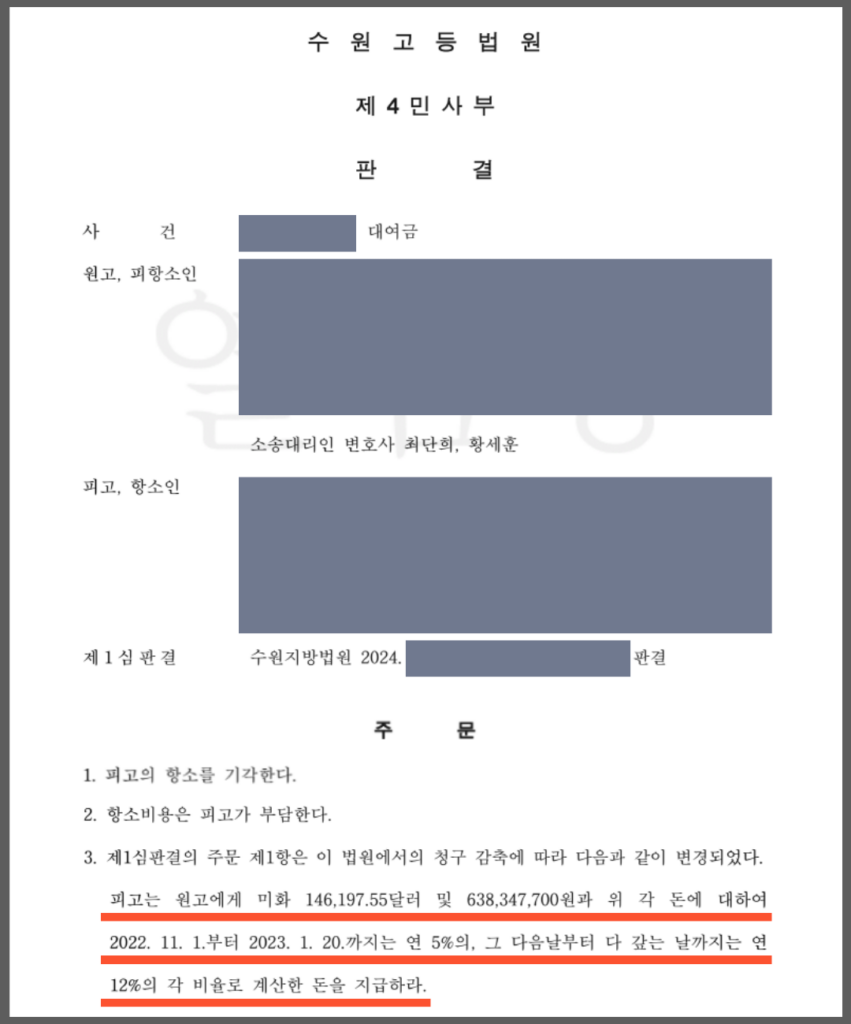
Outcome
As the litigation prolonged, the interest accrual period also extended. In the second trial, our client was awarded approximately USD 840,000 (VND 21.3 billion) at the exchange rate at the time of judgment. The defendant appealed again, but the Supreme Court dismissed the appeal, resulting in our client’s final victory.