
Once the appeal deadline passes, the case is supposed to be over—final, beyond dispute. Even a single day late usually seals the judgment forever. So the idea of reviving a case years later seems unthinkable. That’s why overturning an eight-year-old judgment and turning a prison term into a suspended sentence feels almost miraculous.
Table of Contents
The Defendant Who Fled to the U.S.
While the trial was still pending, our client and his Korean wife fled to the United States with their young daughter. In Korea, the law requires defendants to report even a simple change of address—let alone leaving the country. The prosecutor neglected to request a travel ban, and the defendants slipped out of the country. The trial eventually concluded without them, and the court sentenced both our client and his wife to prison.
Why He Returned to Korea
Eight years passed, and the client wanted to return to Korea. His Korean wife had developed cancer and hoped to receive treatment at her hometown, and he also wanted his wife to be with her family in Korea. But coming back into Korea also meant walking straight into prison under the confirmed sentence. He reached out to SLG after desperately searching for a way out.
Restoring the Right to Appeal
The “restoration of the right to appeal (상소권 회복 청구)” allows a missed appeal to be revived when the failure was not attributable to the defendant. Normally, appeals must be filed within seven days. But if a court’s mistake prevented an appeal, the defendant may regain the right to appeal, even if belated. SLG attorneys carefully reviewed this case, identified the court’s procedural errors, and argued for restoration.
Court’s Judgment
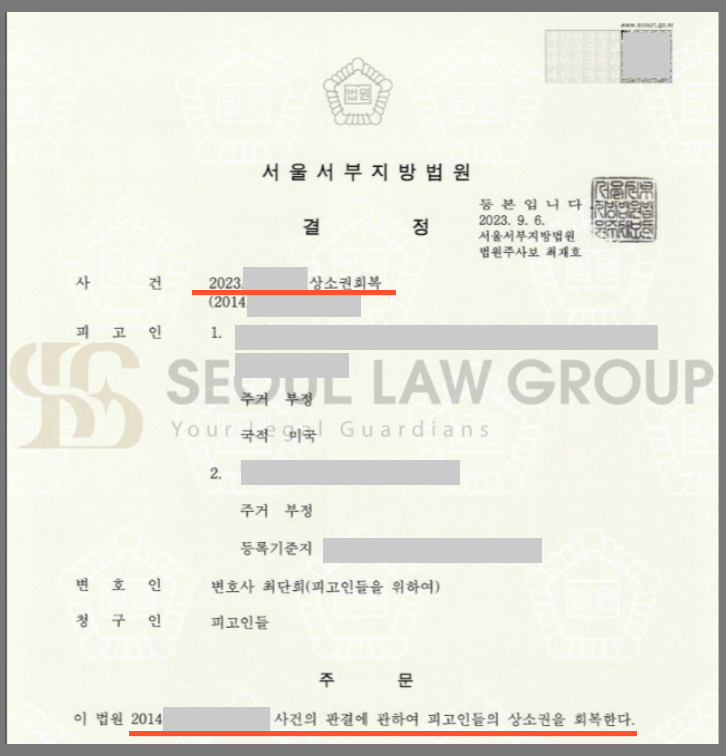
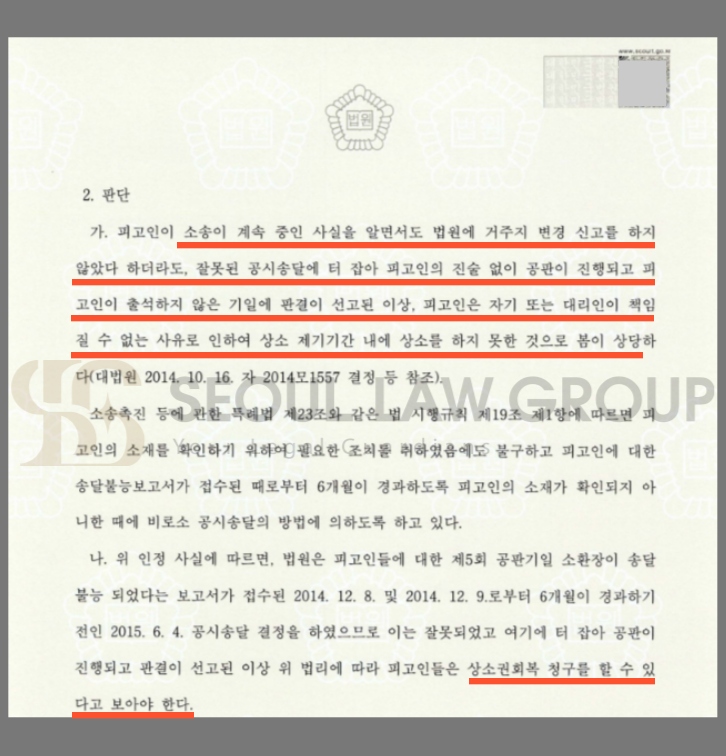
The judgment stated:
“Even though the defendant did not report a change of residence during trial, because the judgment was rendered through defective service and without the defendant’s statement, this must be deemed a reason not attributable to the defendant for failing to appeal within the statutory period.”
In plain terms: while the defendants were indeed at fault for fleeing, the court’s own procedural mistake was recognized as the more fundamental issue. As a result, the defendants were allowed to appeal even after a few years, and in the appellate trial, our client’s wife’s prison sentence was reduced to a suspended execution—a far more favorable outcome.
Could Your Case Also Be Revived?
Many ask, “My case is already final and I disagree with the judgment. Do I still have a chance to reopen it?”
The answer depends on the case review. Procedural errors are more common than people expect, and courts often take a lenient stance toward restoring appeal rights.
Examples where procedural errors have been acknowledged:
- Failure to comply with the statutory period: In the case we just introduced, the court should have waited the six-month period before issuing a “service by public notice (공시송달)” decision against the defendants, but instead rushed to make the decision without completing that period.
- Defective service: delivering documents to a deceased person, or serving at a home address instead of the prison where the defendant was detained.
- No opportunity to be heard: administrative revocation without giving the party a chance to submit arguments.
- Insufficient notice: disciplinary hearings (e.g., school violence cases) were convened without proper advance notice to the party.
Each of these has led courts to recognize procedural defects.
Final Note
Legal procedures are complicated, and mistakes often appear where you least expect them. In law, just as in life, “it’s not over until it’s truly over.”
You can find more of our success stories at the link below.
Forgotten Cannabis, Serious Consequences: What You Need to Know Before Entering Korea
SUCCESS CASE: Avoid Wrongful Punishment for Intimidation in Korea